
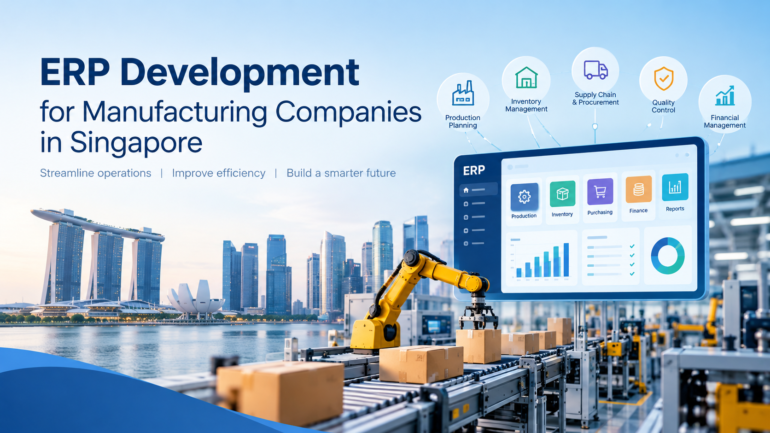
Singapore’s manufacturing sector depends on efficient production, accurate inventory management, reliable supply chains, and consistent product quality. As businesses expand and customer expectations increase, managing these activities through separate software systems or manual processes can become difficult. Manufacturers need a connected approach that improves visibility across their operations and supports better decision-making.
Enterprise Resource Planning (ERP) software helps address these challenges by bringing essential business functions into a unified system. With the right ERP solution, manufacturing companies can coordinate production, purchasing, inventory, finance, and order management more effectively.
This is why ERP Development Singapore has become an important consideration for manufacturers looking to modernize their operations and build a scalable business infrastructure.
Why Do Manufacturing Companies Need ERP Software?
Manufacturing involves several interconnected processes. A delay in purchasing raw materials can affect production schedules, while inaccurate inventory records can lead to shortages or excess stock. When departments rely on disconnected systems, identifying and resolving these issues becomes more complicated.
ERP software centralizes operational information, allowing teams to work with consistent and updated data. Managers can monitor production progress, track material availability, review expenses, and coordinate deliveries from a single platform.
For Singapore manufacturers operating in competitive domestic and international markets, this visibility can support faster responses to changing demand and improve coordination between departments.
An ERP system can also help businesses reduce repetitive administrative work, improve reporting accuracy, and establish more consistent workflows.
Key Features of ERP Development for Manufacturing
A manufacturing ERP solution should reflect the company’s production methods, supply chain requirements, and business goals. The following features are particularly valuable.
1. Production Planning and Scheduling
Production planning helps manufacturers organize work orders, allocate resources, and establish realistic production schedules. An ERP system can connect customer orders with material availability and production capacity.
This allows production managers to identify potential bottlenecks, coordinate manufacturing activities, and adjust schedules when demand or resource availability changes.
A well-planned system can also improve communication between production teams and other departments, reducing confusion and unnecessary delays.
2. Inventory and Warehouse Management
Accurate inventory information is essential for maintaining uninterrupted manufacturing operations. ERP software can track raw materials, components, work-in-progress items, and finished products.
Depending on the system’s configuration, businesses can monitor stock movements, define reorder levels, manage warehouse locations, and record material consumption.
These capabilities help purchasing teams make informed decisions about replenishment while reducing the risk of overstocking or production interruptions caused by unavailable materials.
3. Procurement and Supplier Management
Manufacturers depend on suppliers for raw materials, machinery components, packaging, and other essential resources. Delays or inconsistent purchasing processes can affect production schedules and operating costs.
ERP software can organize purchase requests, purchase orders, supplier details, delivery schedules, and procurement records.
By connecting purchasing with inventory and production planning, businesses can identify material requirements earlier and improve coordination with suppliers.
4. Quality Control and Traceability
Product quality is a critical concern for manufacturers serving customers across different industries. An ERP solution can help document inspections, quality checks, production batches, and non-conformance records.
Where required, batch or serial-number tracking can help businesses trace materials and finished products through relevant stages of production and distribution.
These records support more consistent quality procedures and make it easier to investigate defects or identify affected products.
The exact traceability and compliance features should be designed according to the manufacturer’s industry, customer requirements, and applicable regulations.
5. Financial Management and Cost Tracking
Manufacturing costs include raw materials, labour, equipment usage, utilities, maintenance, and overheads. Tracking these expenses separately can make it difficult to understand the actual cost of production.
An integrated ERP system can connect purchasing, inventory consumption, production records, and financial information. Depending on the costing model, it can help estimate product costs, compare planned and actual expenses, and identify areas where spending requires attention.
Better cost visibility enables managers to evaluate profitability and make more informed pricing and budgeting decisions.
6. Reporting and Business Insights
Manufacturing managers need timely information about production output, machine utilization, inventory levels, order fulfilment, and operational expenses.
ERP dashboards and reports can bring these indicators together, helping decision-makers identify recurring problems and evaluate performance.

For example, a business can investigate why certain orders regularly miss their deadlines or why material consumption exceeds expected levels.
Reporting capabilities should focus on the measures that matter most to the company’s operational and financial objectives.
Benefits of ERP Development in Singapore
Investing in ERP Development in Singapore can help manufacturing businesses establish processes that support both current operations and future growth.
- Improved operational efficiency: Connecting departments reduces duplicate data entry and minimizes the need to reconcile information across separate systems.
- Better resource utilization: Production schedules, inventory records, and purchasing information help teams coordinate the use of materials, labour, and equipment.
- Greater supply chain visibility: Updated purchasing and stock information can help businesses respond more effectively to supplier delays and changing material requirements.
- More informed decisions: Centralized reports provide managers with a clearer view of costs, production performance, and order status.
- Scalable operations: A properly designed ERP system can accommodate additional products, warehouses, production facilities, users, and business processes as the company expands.
These benefits depend on implementation quality, data accuracy, employee adoption, and how well the software matches actual business requirements.
How to Choose the Right ERP Development Services
Selecting suitable ERP Development services requires more than comparing software features. Manufacturers should evaluate how well a provider understands production processes and can translate business requirements into practical system functionality.
Start by documenting existing workflows, operational challenges, reporting needs, and integration requirements. Identify which processes need immediate improvement and which can be introduced in later phases.
Review the provider’s experience with manufacturing systems, inventory management, production planning, data migration, and third-party integrations. Ask how the proposed solution will be tested, secured, maintained, and upgraded.
It is also important to discuss employee training and post-launch support. Even a technically capable ERP system may deliver limited value if employees find it difficult to use or the business lacks a clear implementation plan.
A phased rollout can help manufacturers introduce essential modules first, test workflows, resolve issues, and expand the system as teams become comfortable with the new processes.
Conclusion
Manufacturing companies need reliable information, coordinated workflows, and efficient resource management to remain competitive. ERP software connects production, inventory, procurement, quality, and financial processes, helping businesses gain better control over their operations.
For manufacturers evaluating ERP Development Singapore, the most effective approach is to begin with clearly defined business requirements and choose a solution that balances functionality, integration, scalability, and long-term support.