
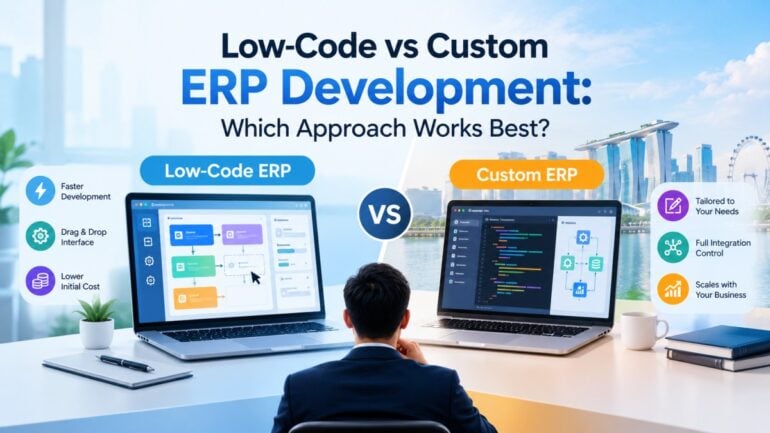
Choosing the right ERP solution is an important decision for businesses planning to improve their operations. The right system can simplify daily tasks, connect departments, and make business information easier to manage. However, not every company needs the same development approach.
Some businesses prefer low-code platforms because they allow applications to be built with minimal programming. Others choose custom ERP development to create software around specific operational requirements. Understanding the differences can help companies select an approach that matches their budget, technical resources, and future plans.
For organizations exploring ERP development in Singapore, the best choice depends on how closely an available platform fits their business processes.
What Is Low-Code ERP Development?
Low-code ERP development uses platforms that provide visual design tools, ready-made components, templates, and workflow builders. Instead of writing extensive code for every feature, developers can configure many functions through graphical interfaces.
This approach can be useful for businesses that need approval workflows, internal dashboards, basic inventory tracking, or connections between existing applications.
Low-code development may shorten the time required to build certain applications. However, the available features, customization limits, licensing costs, and integration options depend on the platform selected.
What Is Custom ERP Development?
Custom ERP development involves designing and building software according to a company’s specific requirements. Developers can create dedicated modules, specialized workflows, and integrations that reflect how the organization operates.
For example, a manufacturing company may require production scheduling linked to machine availability, material consumption, and quality inspections. A standard platform may not support every detail without additional development.
Custom ERP software provides greater control over system architecture and functionality, but it generally requires more planning, development effort, testing, and ongoing technical support.
Key Differences Between Low-Code and Custom ERP
1. Development Time
Low-code platforms can accelerate development when the required functionality fits their existing components. Businesses may be able to launch simple workflows without building every feature from scratch.
Custom ERP projects typically take longer because developers must design, build, and validate more components. The actual timeline depends on project complexity, integrations, data migration, and testing requirements.
2. Initial and Long-Term Costs
Low-code development may reduce initial development expenses, particularly for smaller applications. However, subscription fees, user limits, premium connectors, and platform restrictions can affect the total cost over time.
Custom development usually requires a larger initial investment. Its long-term cost depends on maintenance, hosting, upgrades, support, and future changes. Businesses should compare the total cost of ownership rather than looking only at the initial price.
3. Flexibility and Customization
Low-code tools work well when business processes fit the platform’s capabilities. Complicated workflows may require specialized coding or external integrations.
Custom ERP development offers more freedom to build specific business rules, advanced reporting, and industry-focused features. This can be valuable for organizations with unusual operational requirements.
4. Integration and Scalability
Both approaches can support integration and growth, provided the chosen technology offers suitable capabilities.
Low-code platforms may simplify connections to supported applications, although complex integrations can require additional work. Custom ERP systems can be designed around existing software, data structures, and expected transaction volumes.
For businesses considering ERP development in Singapore, scalability should include performance, security, access control, and the ability to accommodate future operational changes.

Which Approach Is Better for Your Business?
Low-code ERP development may suit small and medium-sized businesses that need straightforward workflows, quick application development, and limited customization.
Custom ERP development may be more appropriate for companies with complex manufacturing processes, specialized inventory requirements, multiple operational locations, or detailed integration needs.
A hybrid approach is also possible. Businesses can use an established ERP platform for core operations while developing selected custom modules or using low-code tools for supporting workflows.
This strategy can balance development speed with the flexibility needed for more specialized processes.
How to Make the Right Decision
Before selecting an approach, businesses should document their current challenges, essential features, integration requirements, available budget, and expected growth.
They should also evaluate data security, employee training, vendor dependence, maintenance requirements, and the ease of modifying the system later.
A small pilot project can help confirm whether a low-code platform meets practical requirements before the business commits to a larger implementation.
Conclusion
Low-code and custom ERP development offer different advantages. Low-code platforms can accelerate the creation of suitable applications, while custom development provides greater freedom for specialized business processes.
The right choice for ERP development in Singapore depends on operational complexity, budget, integration needs, and long-term objectives. SerpentCS helps businesses explore ERP solutions that align with their workflows and technology requirements, enabling them to choose a practical approach for improving efficiency and supporting sustainable growth.